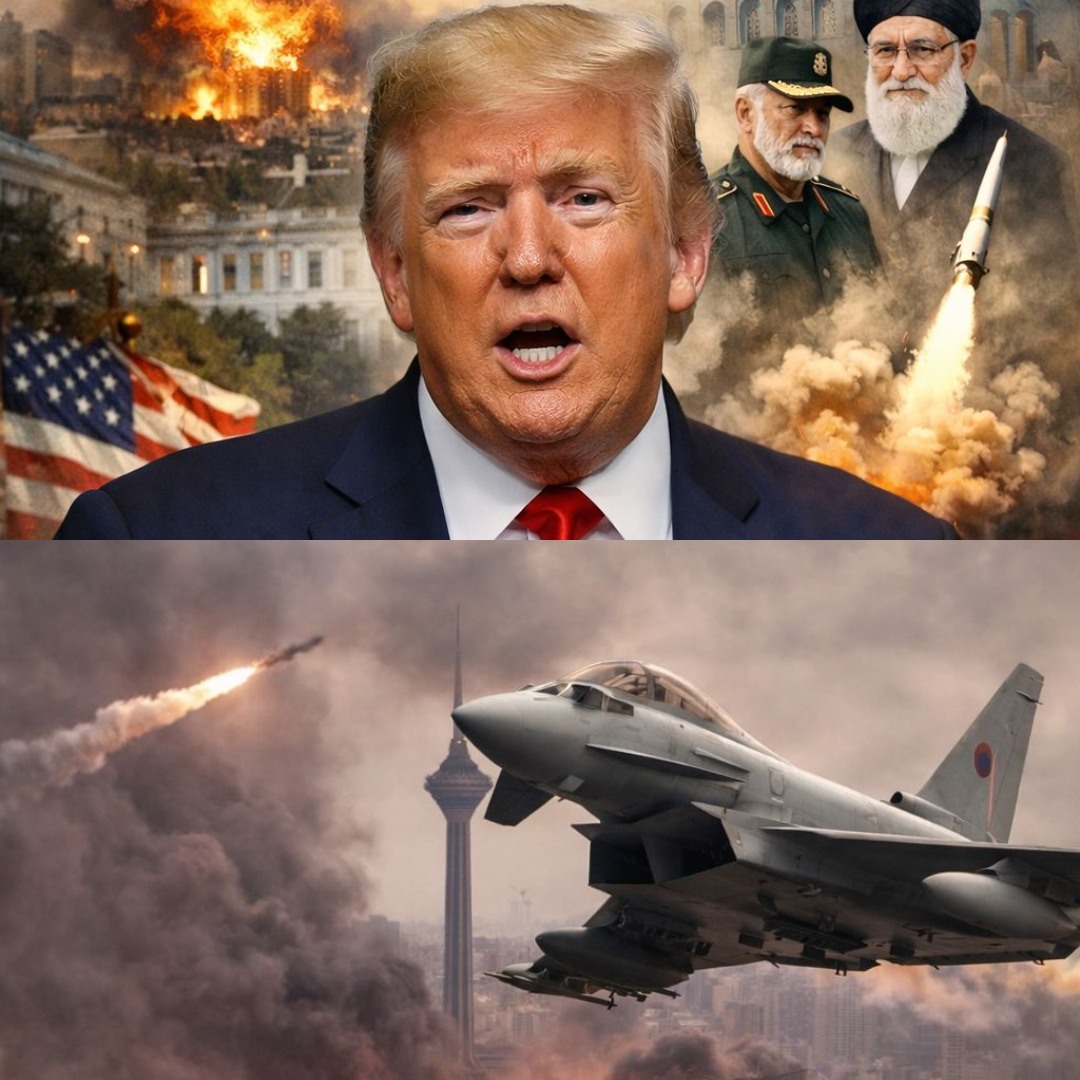
When President Donald Trump declared that “we haven’t even started hitting them hard” and warned that “the big one is coming,” his remarks immediately reverberated far beyond Washington. Directed at Iran, the statement signaled not just frustration or political messaging, but the possibility of a broader strategic shift. In moments of heightened tension, words themselves can become instruments of power — shaping markets, influencing diplomatic channels, and recalibrating military calculations without a single additional move on the ground.
The president’s comments came amid already strained relations. Over recent years, disagreements over missile development, regional influence, and nuclear policy have repeatedly pushed both sides into cycles of pressure and response. Yet this latest language stood out for its tone and timing. By suggesting that stronger measures could arrive soon — and by leaving open the possibility of extended engagement — the administration introduced a new layer of uncertainty into an already fragile landscape.
In public remarks and in an interview with the New York Post, Trump emphasized that the United States is prepared for a conflict timeline that could stretch for weeks, and potentially longer if necessary. That framing is significant. Rather than describing a short, contained episode, he sketched the outline of a campaign that might unfold in phases. The suggestion that what has happened so far represents only an “early phase” invites speculation about what subsequent stages might look like — diplomatically, economically, or militarily.
Rhetoric of this magnitude often serves multiple purposes. At one level, it projects strength to domestic audiences. Political leaders frequently adopt assertive language to reassure supporters that national interests are being defended decisively. At another level, it functions as deterrence. By signaling readiness to escalate, a government may hope to discourage further action from its counterpart. The ambiguity embedded in phrases like “the big one” can be deliberate. Ambiguity leaves room for maneuver, keeps adversaries guessing, and preserves strategic flexibility.
Yet ambiguity also carries risk. Financial markets, for example, respond quickly to uncertainty. Energy prices can shift on speculation alone, especially when tensions involve major oil-producing regions. Investors assess not only the likelihood of military action but also the duration and scope of potential disruptions. Even without concrete developments, strong rhetoric can influence currency values, commodity markets, and long-term investment strategies.
Diplomatically, such statements ripple outward through alliances and rivalries alike. Partners seek reassurance that escalation will remain controlled, while competitors analyze whether words signal imminent action or negotiating posture. International observers weigh the balance between signaling and substance. Is the language meant to extract concessions? Is it an effort to shape the narrative before a new round of talks? Or does it foreshadow tangible steps that have already been set in motion behind closed doors?
For Iran, the calculation is equally complex. Responding too forcefully to rhetoric could accelerate escalation. Ignoring it might risk appearing weak domestically. Governments facing external pressure often calibrate their reactions carefully, issuing statements that assert sovereignty while avoiding moves that could trigger unintended consequences. In such contexts, messaging becomes a strategic dance — each side attempting to project resolve without crossing thresholds that would make de-escalation more difficult.
The historical backdrop adds additional layers of meaning. Relations between Washington and Tehran have experienced repeated cycles of confrontation and negotiation over decades. Sanctions regimes, nuclear agreements, proxy tensions, and regional alignments have each shaped the current environment. When a U.S. president suggests that a “larger response” may be near, the statement draws upon this history. It echoes prior episodes of brinkmanship while introducing fresh variables unique to the present moment.
One of the most closely watched aspects of Trump’s remarks was his refusal to rule out deploying ground forces. While he did not announce any such move, the mere acknowledgment of that possibility widens the spectrum of potential outcomes. In modern geopolitical strategy, the introduction of ground troops represents a significant threshold. Even when described hypothetically, it prompts defense analysts and policymakers worldwide to reevaluate scenarios that had previously seemed remote.
Still, it is important to distinguish between signaling and decision. Leaders often expand rhetorical options without committing to immediate implementation. By stating that all options remain on the table, a government can reinforce deterrence without narrowing its diplomatic pathways. This dual-track approach — pressure combined with openness to negotiation — has characterized many high-stakes standoffs in recent decades.
Domestic political considerations inevitably intersect with foreign policy messaging. Strong statements can rally support among constituents who favor assertive leadership. They can also draw criticism from those concerned about the risks of escalation. In democratic systems, public opinion influences the sustainability of prolonged engagement. The president’s reference to a possible four-week timeframe may reflect an effort to frame expectations — suggesting both seriousness and a degree of temporal containment.
Meanwhile, military planners focus on readiness and adaptability. Even absent new orders, heightened rhetoric requires careful assessment of force posture, logistics, and contingency planning. Defense institutions operate on timelines that differ from political news cycles. Preparations must account for a range of scenarios, from symbolic actions to sustained operations. In that sense, public statements can trigger internal processes designed to ensure preparedness without predetermining outcomes.
Internationally, allied governments seek clarity. They evaluate how potential escalation might affect regional stability, trade routes, and collective security commitments. Some may quietly encourage restraint, while others emphasize solidarity. Multilateral institutions monitor developments closely, aware that sudden shifts in policy can reshape diplomatic agendas and humanitarian considerations alike.
Energy markets are particularly sensitive. The Middle East remains central to global supply chains, and even limited disruptions can ripple outward. Analysts model best-case and worst-case projections, incorporating both rhetoric and intelligence assessments. Insurance rates for shipping, transportation planning, and strategic reserves all factor into the calculus when tensions intensify.
At the same time, communications technology accelerates the spread of every statement. Social media amplifies excerpts, headlines, and commentary within minutes. A phrase like “the big one is coming” becomes a focal point, detached from its broader context and analyzed frame by frame. In this environment, nuance can be lost, but impact can be magnified. Leaders must navigate a landscape where each sentence may carry global implications.
From a strategic standpoint, the use of open-ended phrasing may serve to maintain leverage. By not defining precisely what “the big one” entails, the administration preserves freedom of action. It could refer to economic measures, cyber capabilities, diplomatic isolation, or other instruments of national power. The lack of specificity forces observers to consider a broad range of possibilities, complicating predictive models.
Critics argue that such ambiguity increases anxiety and raises the risk of miscalculation. Supporters contend that unpredictability can strengthen deterrence by preventing adversaries from anticipating responses. Both perspectives highlight the delicate balance inherent in high-stakes diplomacy. Clarity can reduce misunderstanding, yet excessive transparency may constrain strategic options.
The broader regional context also shapes interpretation. Neighboring states monitor developments closely, aware that any significant shift could alter security dynamics. Regional rivalries, alliances, and economic ties intersect in complex ways. A change in posture between Washington and Tehran might influence negotiations elsewhere, from energy cooperation to security partnerships.
Humanitarian considerations remain part of the conversation as well. Extended tensions can affect civilian populations through economic disruption, inflation, and uncertainty. Policymakers must weigh not only strategic objectives but also the broader societal consequences of sustained confrontation. Even absent direct conflict, prolonged standoffs can strain public services and international aid networks.
In assessing the president’s remarks, some analysts emphasize the role of negotiation theory. Strong opening positions can create space for compromise later. By projecting resolve, a leader may hope to enter future discussions from a position of perceived strength. The effectiveness of this approach depends on the counterpart’s assessment of credibility. Words carry weight only when backed by plausible capability and consistent follow-through.
Others caution that rhetorical escalation can become self-reinforcing. Once public expectations are set, leaders may feel pressure to match words with action. Managing that dynamic requires careful calibration, ensuring that flexibility remains even as firmness is displayed. Historical precedents illustrate both successful and unsuccessful examples of this balancing act.
As weeks unfold, attention will focus on signals beyond headlines. Diplomatic engagements, backchannel communications, military movements, and economic adjustments all provide clues about trajectory. Observers look for alignment or divergence between rhetoric and reality. Sometimes strong language precedes de-escalation, serving as a prelude to compromise. At other times, it marks the beginning of a more sustained shift.
The concept of a four-week window introduces a narrative arc. Timeframes create anticipation and structure public discourse. Whether that estimate proves accurate or evolves, it frames the situation as dynamic rather than indefinite. Stakeholders across sectors — government, finance, industry, and civil society — adjust plans accordingly.
Ultimately, the meaning of “the big one” remains open to interpretation. It may represent a strategic inflection point, a negotiating tactic, or a deterrent signal designed to prevent further escalation. Its power lies partly in its vagueness. By capturing attention while withholding specifics, it compels audiences to watch closely.
In global politics, perception often shapes reality. If markets believe escalation is imminent, they behave as though it is. If adversaries perceive credible resolve, they adjust strategies. If allies sense unpredictability, they seek reassurances. Thus, a single phrase can cascade through interconnected systems, influencing decisions far removed from the original statement.
For now, the world waits to see whether rhetoric translates into concrete change. The coming weeks may clarify whether this moment marks a decisive turn or another chapter in a long-running cycle of tension and negotiation. As analysts debate probabilities and policymakers refine options, one truth remains constant: in geopolitics, words are never merely words. They are signals, tools, and sometimes catalysts.
Whether “the big one” ultimately refers to a diplomatic breakthrough, intensified pressure, or something else entirely will depend on choices made in capitals across the globe. The interplay between signaling and substance will determine not only the immediate trajectory but also the longer-term balance of stability and competition.
Until clearer signals emerge, uncertainty itself becomes the defining feature. And in an interconnected world, uncertainty commands attention.