
WHEN HALFTIME BECOMES A STATEMENT: POWER COUPLES, VALUES, AND THE BATTLE FOR ATTENTION
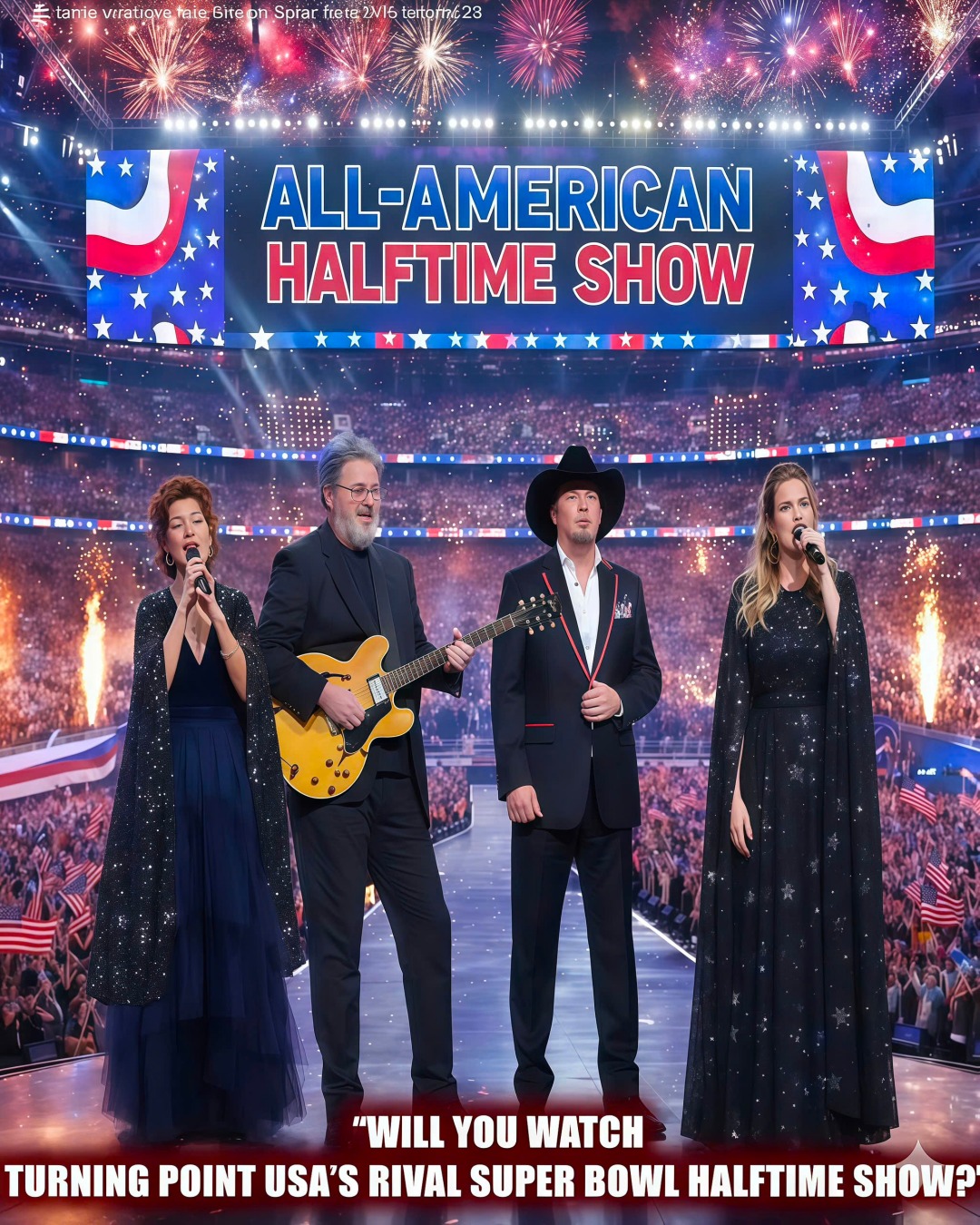
Super Bowl halftime has always been more than a musical intermission. It is a cultural signal—an indicator of what the country is paying attention to, what it celebrates, and which voices are elevated on the largest stage in American entertainment. This year, that signal feels less settled than usual. A growing wave of online discussion has centered on Erika Kirk’s “All-American Halftime Show,” a project described as values-driven and message-first, and on the possibility that it could run live during the same halftime window as the Super Bowl itself.
What has propelled the conversation into overdrive is the association of two legendary husband-and-wife duos—Garth Brooks and Trisha Yearwood, alongside Vince Gill and Amy Grant—with the concept. These are not just well-known artists. They are cultural fixtures, whose careers and public lives have been intertwined with themes of faith, family, and continuity for decades. The idea of both couples appearing within the same halftime moment has reshaped the debate, turning it from speculation about programming into a broader argument about meaning.
At its core, the conversation is about contrast. Modern Super Bowl halftime shows have increasingly emphasized global pop culture, spectacle, and visual excess. That approach reflects a media environment optimized for viral reach and international audiences. Supporters of that model argue that it mirrors a diverse, interconnected world and keeps the event relevant to younger viewers.
The All-American Halftime concept positions itself in deliberate opposition to that trend. It is framed around restraint rather than excess, legacy rather than novelty. Faith, family, and patriotism are cited as organizing principles, not as slogans but as cultural touchstones. The involvement of married artist couples reinforces that framing, signaling stability, partnership, and shared values rather than individual stardom.
Garth Brooks and Trisha Yearwood, in particular, carry immense symbolic weight. Brooks’ career reshaped country music’s commercial reach, while Yearwood’s voice and public persona have long been associated with warmth and authenticity. Together, they represent a version of American music rooted in storytelling and emotional accessibility. Vince Gill and Amy Grant add another layer, bridging country and Christian music traditions that have shaped millions of listeners’ lives. Their partnership is often cited as an example of faith expressed through craft rather than proclamation.
Supporters interpret the pairing of these couples as intentional and meaningful. To them, it suggests a halftime experience that prioritizes connection over spectacle, and message over marketing. They describe it as a return to a form of cultural expression that feels familiar and grounding in a media landscape dominated by constant reinvention.
Critics see the symbolism differently. They argue that elevating certain artists and values risks narrowing the definition of what belongs on a national stage. In a country defined by pluralism, they caution, framing one vision of culture as “All-American” can implicitly exclude others. From this perspective, the issue is not the artists themselves, but the narrative being constructed around them.
The intensity of the debate has been amplified by claims about timing and platform. The suggestion that such a show could air live during the Super Bowl halftime window—rather than as a recap or post-event commentary—has raised the stakes. Halftime is one of the most valuable and tightly controlled segments in broadcast television. Challenging it directly, even conceptually, reframes attention as a choice rather than a default.
That reframing is what has unsettled many observers.
For decades, the Super Bowl has functioned as one of the last shared rituals in American life. Even viewers uninterested in football often tune in for the commercials or the halftime show, participating in a collective moment that transcends individual preference. Introducing a parallel option during the same window threatens that convergence, potentially splitting audiences along cultural or ideological lines.
Supporters argue that this split reflects reality rather than causing it. They contend that audiences are already fragmented, and that offering a values-driven alternative simply acknowledges that fragmentation while giving people agency. In their view, choice is not divisive; it is honest.
Opponents counter that shared experiences matter precisely because they force people to coexist within difference. Halftime, they argue, is valuable because it is imperfect but communal. Turning it into a point of competition risks accelerating cultural isolation, replacing shared reference points with parallel narratives that never intersect.
The silence of major networks has become a focal point of interpretation. In the broadcast industry, significant programming moves are typically announced with clarity and coordination. The absence of official statements has fueled speculation, with some interpreting the quiet as strategic restraint and others as uncertainty. Media analysts note that silence, intentional or not, often amplifies attention in a digital environment hungry for signals.
Another element driving engagement is the unresolved finale detail repeatedly referenced in discussion. Endings matter. They are what linger in memory. The idea that a key closing element is being withheld has turned the finale into a symbol—something audiences project meaning onto. Supporters imagine a unifying moment of reverence. Critics worry about a closing gesture that could feel declarative or exclusionary. The lack of detail keeps both possibilities alive.
From a cultural standpoint, the prominence of married couples is significant. Popular music often celebrates individualism, reinvention, and personal freedom. Centering partnership and longevity pushes against that narrative. It suggests that commitment itself can be a form of cultural statement. For some, that is reassuring. For others, it feels prescriptive.
Historically, American music has always negotiated between tradition and change. Country and rock were once disruptive forces themselves, challenging established norms before becoming institutions. The current debate echoes those earlier tensions, but at a scale amplified by social media and the symbolic weight of the Super Bowl.
What makes this moment distinct is how quickly it has moved beyond the specifics of music into questions of identity. The argument is no longer about which songs might be played, but about what halftime represents. Is it a global showcase or a national mirror? A celebration of diversity or a reaffirmation of roots? The answer varies depending on who is asked.
Industry observers point out that even the perception of a rival halftime experience has implications. Advertisers and networks depend on predictability, and the Super Bowl’s value has always rested on its ability to guarantee mass attention. The idea that attention could be meaningfully redirected—even temporarily—introduces uncertainty into that model.
Yet uncertainty is also a sign of change. Media landscapes evolve when assumptions are challenged. The conversation around the All-American Halftime concept suggests that audiences are increasingly willing to question defaults, even those as entrenched as Super Bowl Sunday.
Whether a live parallel broadcast ultimately materializes is, in some ways, secondary to the shift already underway. The halftime window no longer feels like a fixed point. It feels like contested terrain, where meaning is negotiated rather than assumed.
In the end, the involvement of iconic husband-and-wife duos has given the debate a human face. It has grounded abstract arguments about culture and values in recognizable relationships and voices. That grounding is why the story has traveled so far, so fast.
Super Bowl halftime has always told a story about America. This year, the story being argued over is not just who performs, but who decides what that performance should stand for. Whether the result is unity, division, or something in between, the conversation itself marks a turning point.
Attention, once automatic, is now a choice. And when the country is asked to choose—even implicitly—it reveals not just what people watch, but what they believe their biggest moments should mean.