
WHEN HALFTIME BECOMES A TEST OF ATTENTION
For decades, the Super Bowl halftime show has existed as an untouchable fixture in American culture. It is more than a break in a football game; it is a mass ritual, a moment when attention briefly converges across politics, geography, and taste. That convergence has long been treated as inevitable. Recently, however, the conversation around halftime has shifted in a way that suggests inevitability may no longer be guaranteed.
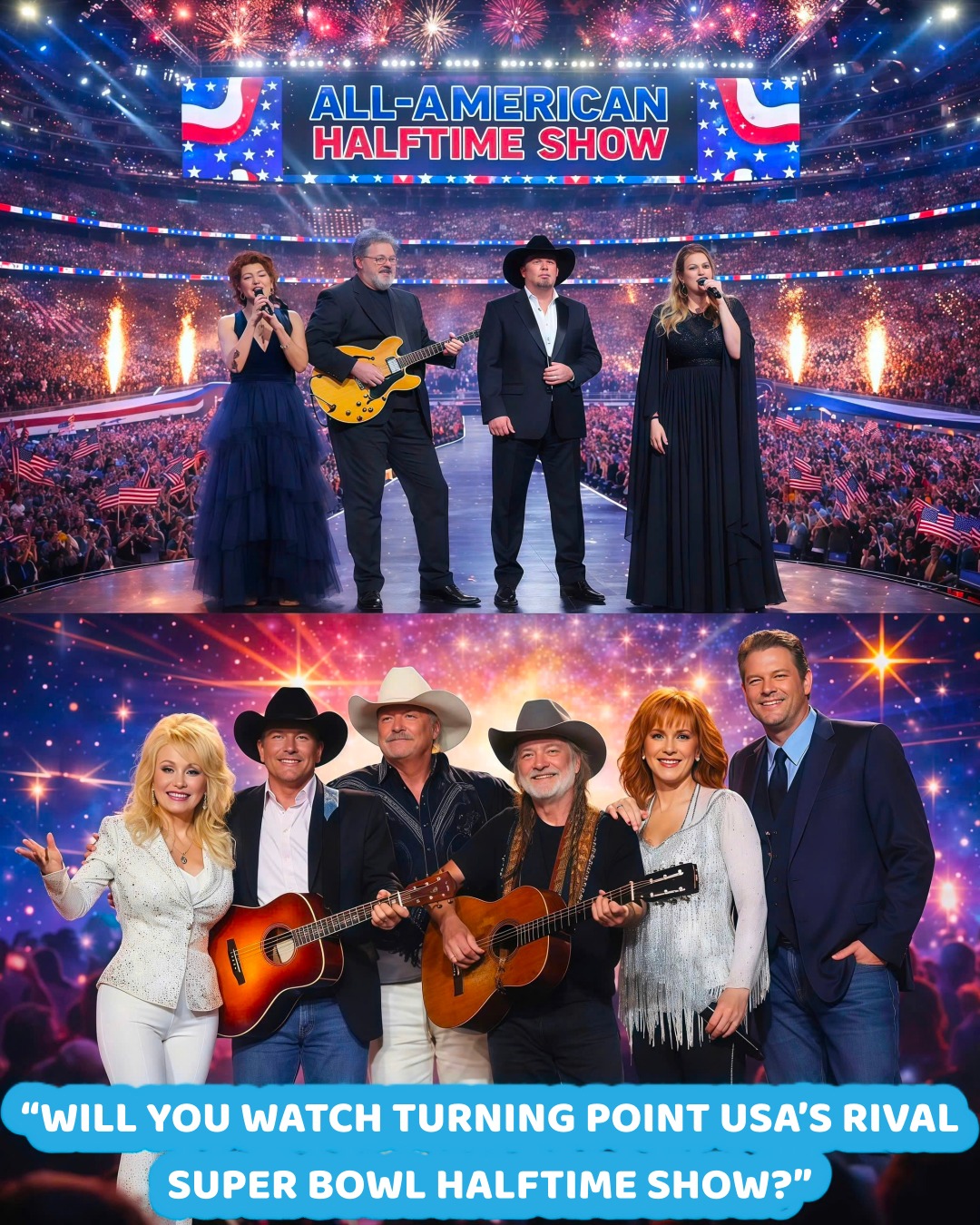
The shift is being driven by growing discussion of a live, message-first broadcast described as the “All-American Halftime Show,” positioned to run during the same halftime window as the Super Bowl. What has captured public attention is not merely the idea of an alternative program, but the framing: this is not presented as a recap, reaction, or counter-program in the traditional sense. It is framed as a simultaneous moment, designed to compete for attention in real time.
That distinction matters.
Counter-programming has always existed in television, but it usually occupies the margins. What is being discussed now occupies the center. The halftime window is among the most valuable minutes in broadcast history, drawing audiences that advertisers, networks, and artists have spent decades cultivating. To suggest that a parallel broadcast could challenge that dominance is to challenge an assumption that has shaped American media for generations.
The All-American Halftime concept is described as message-first rather than spectacle-first. Where modern halftime shows emphasize scale, surprise, and global appeal, this idea emphasizes restraint, legacy, and values. Faith, family, and patriotism are consistently cited as its core themes. Supporters see those themes as restorative, arguing that the nation’s largest stages have drifted away from the cultural foundations that once gave them coherence.
Critics see something more disruptive. They argue that introducing a values-driven broadcast into the halftime window risks transforming one of the last shared cultural moments into a site of division. From this perspective, the issue is not whether alternative content should exist, but whether the timing itself reframes participation as allegiance.
The tension between those interpretations has fueled intense engagement online. Comment sections, podcasts, and social feeds are filled with debate not just about programming, but about identity. The conversation has moved quickly from “what is airing” to “what does watching mean.”
What has amplified the discussion is the absence of concrete detail around one central question: which network would be willing to do this.
In the television industry, risk is carefully managed. Schedules are planned months in advance, advertisers expect stability, and major events are treated as fixed points rather than opportunities for experimentation. The idea that a network might willingly place a live broadcast directly against the Super Bowl halftime window feels radical precisely because it violates those norms.
That is why the unnamed network has become the focal point of speculation.
Silence, in this case, has functioned as an accelerant. Without a named broadcaster, audiences have filled the gap with interpretation. Some view the quiet as strategic restraint, suggesting that withholding the name preserves leverage or anticipation. Others see it as uncertainty, noting that major programming decisions are typically announced with clarity and coordination. Media analysts caution that silence should not be mistaken for confirmation, but they also acknowledge that ambiguity has become a powerful driver of attention in the digital era.
Beyond logistics, the framing of the broadcast as “for Charlie” has added another layer of meaning. Supporters interpret the phrase as continuity and tribute, signaling that the project is rooted in legacy rather than novelty. Critics question what that framing implies about purpose and audience. Without elaboration, the phrase has taken on symbolic weight, allowing different groups to project their own understanding onto it.
The debate reveals a deeper shift in how cultural authority is perceived. For much of broadcast history, authority flowed from a small number of institutions—networks, leagues, studios—that defined what constituted a national moment. Social media and streaming have steadily eroded that centralization, fragmenting attention and empowering niche audiences. The Super Bowl has remained an exception, one of the last events capable of briefly restoring mass focus.
The idea of a live rival broadcast challenges that exception.
Supporters frame the challenge as overdue. They argue that attention should be earned rather than assumed, and that audiences deserve meaningful alternatives rather than default spectacles. In this view, the All-American Halftime Show is less about opposition than about choice. It offers viewers a way to opt into a different tone without waiting for permission.
Critics counter that this framing ignores the social value of shared moments. They worry that turning halftime into a choice between competing messages accelerates fragmentation, reducing a rare point of unity into parallel experiences that never intersect. From this perspective, the danger lies not in content, but in timing—specifically, the decision to contest the very moment when attention is most unified.
Industry observers note that even the discussion of a rival broadcast has implications. Advertisers value certainty. Networks value predictability. The suggestion that attention could be siphoned away during halftime introduces uncertainty into an ecosystem built on guarantees. Whether or not a rival broadcast materializes, the conversation alone has already disrupted assumptions about the stability of the halftime window.
Another element fueling discussion is the language used by both sides. Supporters speak of “revival,” “restoration,” and “reclaiming.” Critics use words like “provocation,” “division,” and “boundary-crossing.” These are not neutral terms. They signal that the debate is not about ratings alone, but about belonging and legitimacy.
In that sense, the All-American Halftime conversation functions as a proxy for broader cultural anxieties. Who decides what represents the nation? Can a single stage still speak to everyone? And what happens when competing visions of identity demand the same spotlight?
The notion that the broadcast would be difficult to interrupt or remove once live has also captured attention. In an era defined by debates over moderation, platform control, and censorship, the idea of a resilient broadcast carries symbolic significance. It suggests permanence in a media environment where content often feels ephemeral.
Whether that symbolism is intentional or inferred, it resonates with audiences who feel fatigued by volatility and eager for stability. At the same time, it alarms those who worry about accountability and oversight. Again, the absence of detail has allowed the idea to absorb meaning from both sides.
Historically, moments of media disruption often begin as challenges to habit rather than direct confrontations. The most effective disruptions are not always loud; they are well-timed. Challenging the halftime window is powerful because it targets routine. Millions of viewers watch the Super Bowl not out of passion, but out of custom. Being asked to choose—explicitly or implicitly—forces a reconsideration of that habit.
Why do people watch?
What does watching signify?
And what does it mean to turn away?
The All-American Halftime debate has made those questions unavoidable.
For now, the concept exists primarily as a focal point for discussion rather than as a fully articulated broadcast. But ideas do not need execution to exert influence. They can reshape expectations, alter conversations, and expose fault lines simply by being taken seriously.
In that sense, the halftime window has already changed. It no longer feels like a guaranteed monopoly of attention. It feels contested, even if only in imagination. That shift alone marks a turning point in how cultural moments are understood.
Whether the unnamed network ever steps forward, whether a live rival broadcast ever airs, the conversation has revealed something fundamental: attention is no longer automatic. It is negotiated. And once that negotiation becomes visible, even the biggest nights are no longer beyond question.
Super Bowl Sunday may still dominate the calendar. But the idea that it stands alone has been disrupted. And in a media landscape where attention is the most valuable currency, that disruption—real or imagined—has already made an impact that will not be easily undone.