
The Defense Department has identified a fifth Army Reserve soldier killed when an Iranian drone struck a U.S. facility at the Port of Shuaiba, Kuwait on March 1. Officials also released the name of a sixth soldier who is “believed” to have been killed in the attack, but for whom official identification was still pending.
Officials initially said six soldiers were killed in the March 2 attack but identified only four in the days after, withholding the names of the final two because they were listed as “unaccounted for” in the immediate aftermath of the attack.
Maj. Jeffrey R. O’Brien, 45, of Waukee, Iowa, was killed in the drone attack, military officials said.
Chief Warrant Officer 3 Robert M. Marzan, 54, of Sacramento, California, was identified as the sixth soldier missing in the attack and, according to Pentagon officials, is now “believed to be the individual who perished at the scene.”
A medical examiner is still working to positively identify Marzan, a Pentagon news release said.
“Out of respect to the family, the Army Reserve will not release the service verification or photo of Chief Warrant Officer 3 Robert M. Marzan until the medical examiner completes positive identification,” Army Reserve spokesman Lt. Col. William Allred, said in a statement to Task & Purpose on March 5.
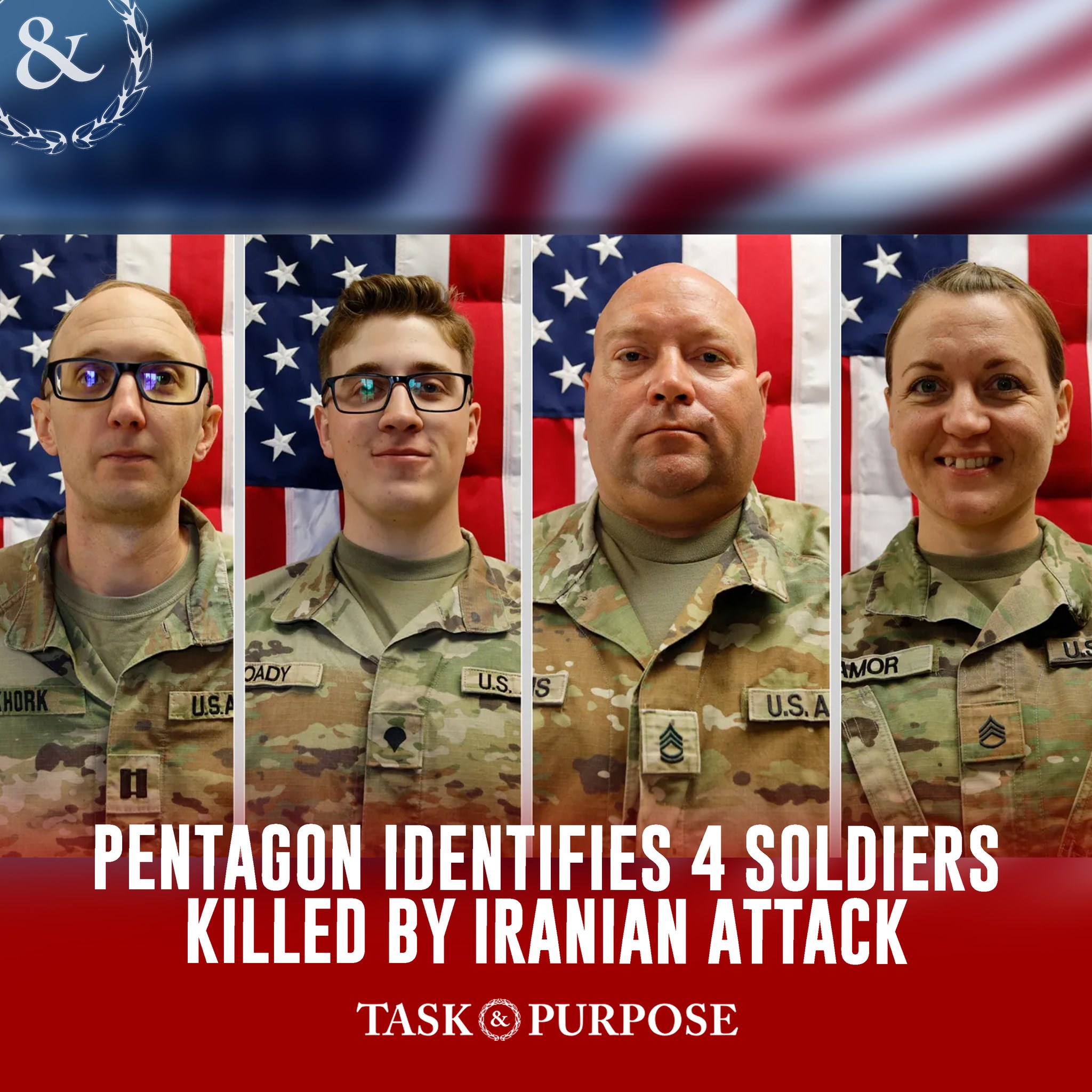
On March 3, the Pentagon identified four other Army Reserve soldiers killed in the attack: Capt. Cody A. Khork, 35, of Winter Haven, Florida; Sgt. 1st Class Noah L. Tietjens, 42, of Bellevue, Nebraska; Sgt. 1st Class Nicole M. Amor, 39, of White Bear Lake, Minnesota; and Sgt. Declan J. Coady, 20, of West Des Moines, Iowa.
All six soldiers who have been identified were assigned to the 103rd Sustainment Command, based out of Des Moines, Iowa. The incident is under investigation.
“We honor our fallen Heroes, who served fearlessly and selflessly in defense of our nation,” Lt. Gen. Robert Harter, Chief of Army Reserve and Commanding General U.S. Army Reserve Command, said in a statement. “Their sacrifice, and the sacrifices of their families, will never be forgotten.”
The drone attack came as retaliation for U.S. and Israeli air and missile strikes against Iran, which began on Feb. 28. Defense Secretary Pete Hegseth told reporters on March 2. that the munition used in the attack had managed to penetrate U.S. air defenses.
U.S. Central Command, or CENTCOM, initially announced on March 1 that three U.S. service members had been killed and several others wounded in the attack. CENTCOM subsequently announced the following day that a fourth service member had died from their injuries and two other fallen troops who had been unaccounted for were also recovered.
News media outlets have raised questions about whether the tactical operations center in Kuwait, where the six service members were killed, had adequate protections against missiles and drones.
Defense officials have pushed back on such new reports by arguing the U.S. military has gone to great lengths to protect American service members in the Middle East.
As of March 4, the Iranians had retaliated to U.S. and Israeli strikes by firing more than 500 ballistic missiles and 2,000 drones at U.S. partners in the Middle East, including those that host American military installations such as Qatar and Bahrain, defense officials said.
So far, U.S. military officials have not said publicly which American installations in the region have been attacked or the extent of the damage they have sustained.
The strikes against Iran came after a weeks-long U.S. military buildup in the Middle East, during which the planes, ships, and missile defenses were dispatched to the region.
The aircraft carriers USS Gerald R. Ford and USS Abraham Lincoln and their respective strike groups are supporting ongoing operations against Iran. Each strike group includes several squadrons of fighter jets as well as destroyers escorting them.
The United States also moved several squadrons of fighter jets into the CENTCOM area of responsibility, including F-15s, F-16s, F-22s and F-35s. They join air units already in the area that have been taking part in operations against the Islamic State over the last three months.
Additionally, the U.S. fielded its new Low-cost Unmanned Combat Attack System, or LUCAS drones in combat for the first time on Feb. 28. It is still unclear which targets the drones attacked or how widespread their use was, but the cheap one-way drones are specifically modeled on Iran’s own Shahed-136 kamikaze drones, which have been widely used in recent fighting around the region.